What an AI Render Leaves Out: A Neuroscientist on How We Use AI
Updated: Sep 2
We were standing in the driveway of the house he is about to buy, talking through how it could be remodeled, when he held up his phone. That morning he had photographed the front facade and asked ChatGPT to reimagine it: an early-1900s townhome with a Spanish Revival feel. Arched openings, smooth stucco, a low tile roof. His taste is good. The image was a fair place to start.

Standing there, though, I could see what the picture had quietly skipped. What it showed in a single frame would take weeks of drawing and a lot of thinking to pull off. The render looks like an answer. It is closer to a wish.
I understand why it works. It looks finished. But a house is something you stand inside every day, and the gap between a convincing image and a place you can live in is wider than it looks. A neuroscientist recently gave me the words for why it matters.

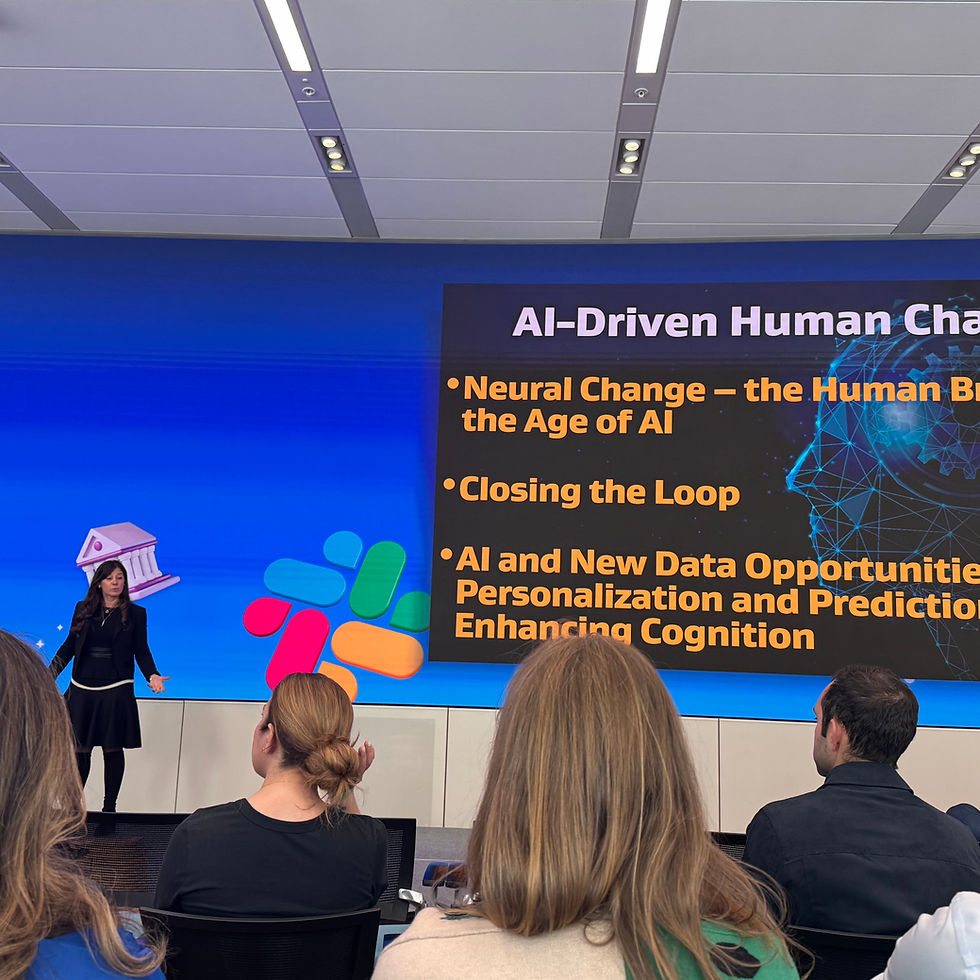
At Salesforce Tower
In May I went to a CoreNet Global talk by Dr. Poppy Crum. She is a neuroscientist, a Stanford adjunct professor, and the former chief scientist at Dolby. Her subject was what she calls the cognitive tax: the quiet cost the human brain pays in the age of AI.
The idea that stuck with me is neuroplasticity, the way our tools and our rooms physically rewire the brain over time. She used the word architecting. The technologies you touch every day are shaping, she said, or architecting your brain. If a room and a tool can reshape how a mind works, then how we use AI is not a matter of taste. It is doing something to us.
Use it or lose it
Crum reached for an example I keep thinking about. London cab drivers spend years memorizing the city's streets, and the part of the brain that holds spatial maps, the hippocampus, physically grows to carry it. Then GPS arrived. “You take away your GPS,” she said, “and we're not very good.” The map never gets built, because nothing makes us build it.
There is early evidence the same thing happens with writing. A 2025 MIT study put people under EEG while they wrote essays, some with an AI assistant and some without. The ones leaning on the AI showed the weakest brain activity, and, oddly, the least sense that the work was theirs. Many couldn't quote a line they had just written. The researchers call what's left cognitive debt. It is one study, not a verdict, and Crum is careful to say so. The pattern is still hard to unsee.
“The quick things that make us faster can also make us dumber and take away our cognitive capabilities.”— Dr. Poppy Crum
Drive, or refine
Crum splits it cleanly. Are you using the tool to think better, or using it to skip the thinking and go faster? Same tool, opposite results. A doctor who already knows medicine can use AI to sort information and stay sharp. A student who hands over the whole essay gets the answer and keeps none of the understanding.
That is the difference between how most people use AI and how a professional does.
The general user lets the machine drive the result. I use it to refine one.
What the AI render leaves out
Which brings me back to the driveway.
A photo is one flat frame. A house is four-dimensional. You move through it across a day, and the light moves with you. The kitchen that glows at eight in the morning can bake behind a west wall at five. The image can't feel that. You will, every afternoon, for years.
Then there is everything a picture can't carry. How sound softens under the right ceiling. Whether the air feels fresh or close. Where the glare lands on your screen in July. Crum showed a slide on exactly this, a study on how the spectrum of ambient light changes attention and comfort. Light is not wallpaper. It is designed, and it shapes how a mind works in the room. None of that survives in a JPEG.

Under all of it sits the part no one sees. The structure that carries the addition. The code that governs the stairs and the exits. The mechanical systems. The budget. A render shows a finished result with none of the constraints the design had to solve, and solving them is the actual work.
His instinct, by the way, was right. An early-1900s facade wants real proportion, a proper base and cap, honest materials, shadow in the right places. A render can borrow that look in a second. Earning it on his specific house means resolving the existing structure, where a new addition meets the old roofline, the budget, and the code, until the style holds up in three dimensions and not just on a screen. The picture borrows the look. The design has to earn it.
How I actually use it
Crum's larger point is that our surroundings shape us, slowly, physically. If that's true, then designing a house is designing someone's daily experience, the light they wake up in and the quiet they come home to. That is not a surface you generate. It is an outcome you work out.
So where do I land on AI? I use it. In my own practice, it helps me test options and push an idea further, faster. It is a sharp assistant with good instincts. It is not the architect. It refines the result. It doesn't drive it.
That buyer's idea is worth doing. It just needs the work the image skipped. If you are holding a render and wondering what it would take to really live in that house, that is the conversation worth having. The gap between the image and the experience is where my work starts.
See how I work: studiocchen.com/process
Further reading: Dr. Poppy Crum on Huberman Lab; the Maguire London taxi driver study; and the MIT study, “Your Brain on ChatGPT.”

Comments